
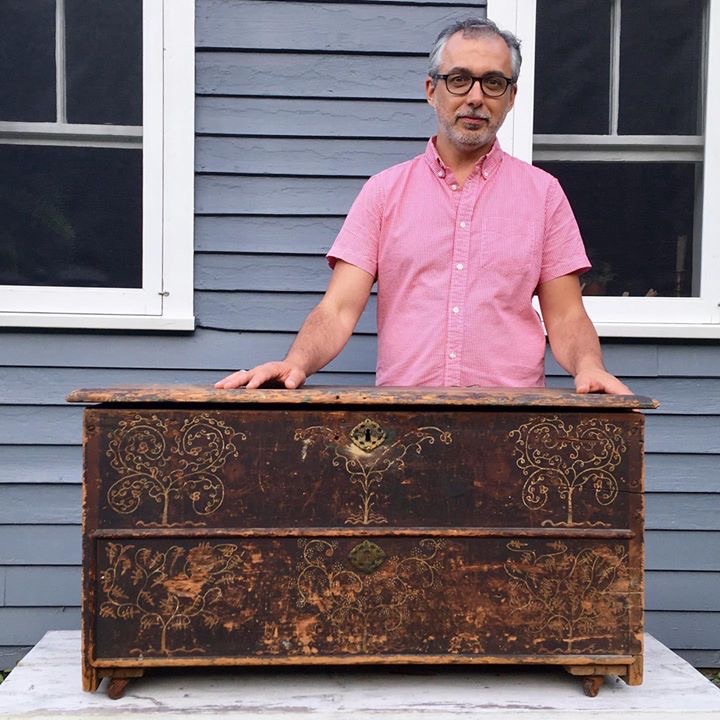
Me (Phil Warish) with the fragmentary Taunton/Crosman chest I found in 2018. Growing up in Taunton, I knew of these chests but never imagined that I’d someday find one. Dated 1726, it’s the earliest of the 27 known and one of only four in private hands. FWIW, I now know the odds of being struck by lightning are 1/700,000 per year or 1/3,000 per lifetime—definitely greater than finding a Crosman chest, so be careful out there.
I first walked into my future employer’s home at age fifteen. She was a painter and retired art educator. Her late husband had been a Merchant Marine chief engineer and spent years bringing home shipping containers of objects—gifts for her—from around the world.
Their 1880s, thirty-plus-room mansion was overflowing with glass, porcelain, sculpture, and textiles like I had never seen, before. I was lucky to spend four days a week there for the next three years and the experience definitely reinforced my love of “stuff.”
By the time I began selling art and antiques in the early 2000s, I was already a working graphic designer. Design school had taught me to see and appreciate how form, color, texture, and craftsmanship—even small deviations within them—can trigger, leverage, or shape emotional responses.
Over time, I realized I’m most drawn to objects that embody a design sensibility, leverage the nuanced qualities mentioned above, yet sit just outside the conventional… the “other.” When those characteristics or concepts overlap and compound, the result can be magical… something felt instantaneously through the hair on your arm.
I’m grateful for the collectors, scholars, and fellow dealers who’ve supported and mentored me in the schools of material culture and proud of what this practice has become: sometimes great, sometimes weird, always and forever rooted in that magical overlap.
Revisiting Taunton: Robert Crosman, Esther Stevens Brazer, and the Changing Interpretations of Taunton Chests.
Robert Crosman painted chest, 1726 (p.162)
Mystery and Benevolence
Ensemble of Lodge aprons, c.1875–1925 (p.134)
Southern Quilts: Celebrating Traditions, History, and Designs
Coxcomb and Currants quilt (p.129)
Brooklyn Museum of Art
Bent mahogany chair, David Wolcott Kendall (CUR.2013.33)
Fenimore Museum
Regular contributor to the Plowline Photograph Collection
I’ve always been a collector, mostly of traditional Dan and Mende sculpture from West Africa and the letterpress gear I still use. I mention it only because I’m somehow still looking for more.
You can see part of my collection here.